
Deadlift Max Calc
You don’t need to max out to know roughly what you could lift once. Enter a recent deadlift set — weight and reps — and the calculator estimates your one-rep max with six common formulas, then builds a percentage chart for your training. It works in pounds or kilograms, and for other lifts too.
- Free to use
- No sign-up
- Runs in your browser
Deadlift 1RM calculator
Deadlift Training Template Pack
Training log spreadsheet with automatic e1RM, printable percentage chart, 12-week deadlift progression template, warm-up and plate-loading sheet and a personal records tracker.
- Training log (XLSX)
- Percentage chart (PDF)
- 12-week template (PDF/DOCX/XLSX)
- Warm-up sheet (PDF)
- PR tracker (PDF/DOCX/XLSX)
Formats: XLSX, PDF, DOCX. Instant download after payment (link valid 72 hours, up to 5 downloads). AI-assisted: the templates were drafted with AI help and reviewed and laid out before publishing.
$5.00 USD, one-time 5 files · about $1.00 each
- Instant download
- 7-day refund
- Secure checkout by Stripe
7-day money-back guarantee. Full refund within 7 days of purchase, even after you download.
Free sample: Training Log e1RM (PDF, 72 KB)
Full refund within 7 days — see the refund policy and license.
Free printables
Single sheets you can print right now, no sign-up. The full pack adds every sheet in one download plus the editable files.
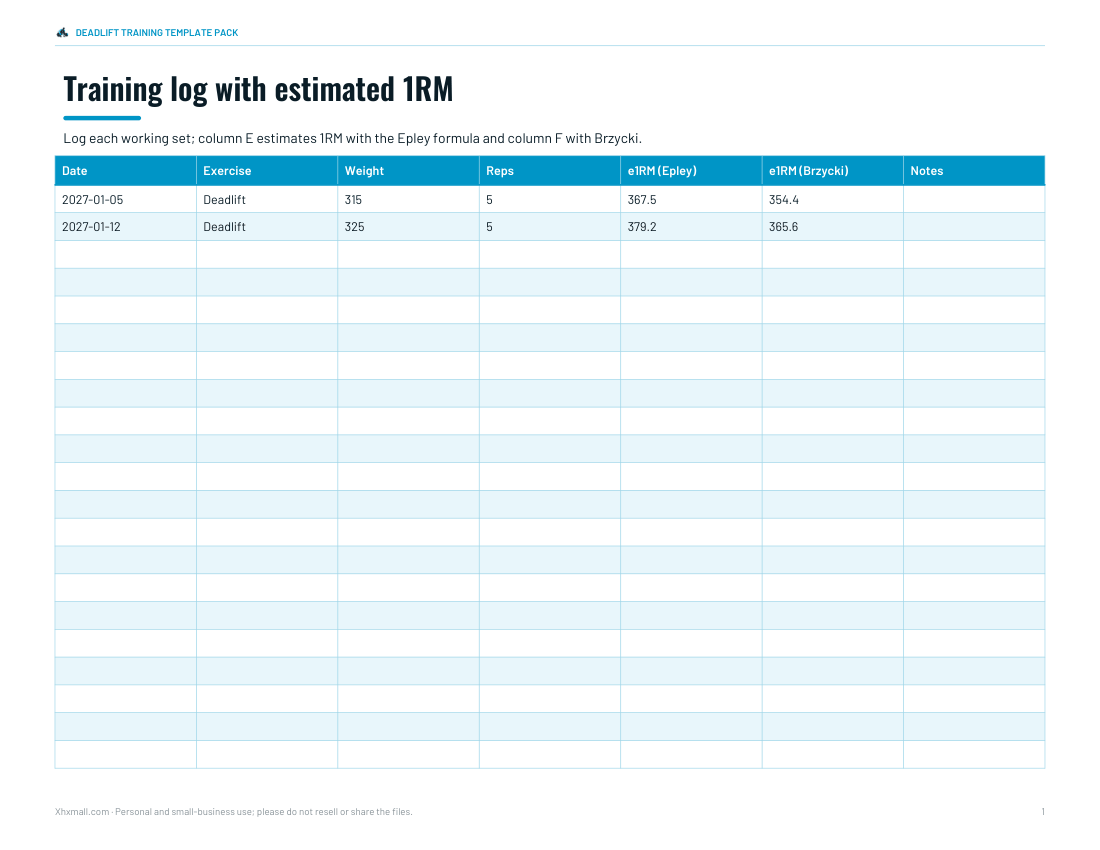
 Deadlift Training Log with 1RM Estimates
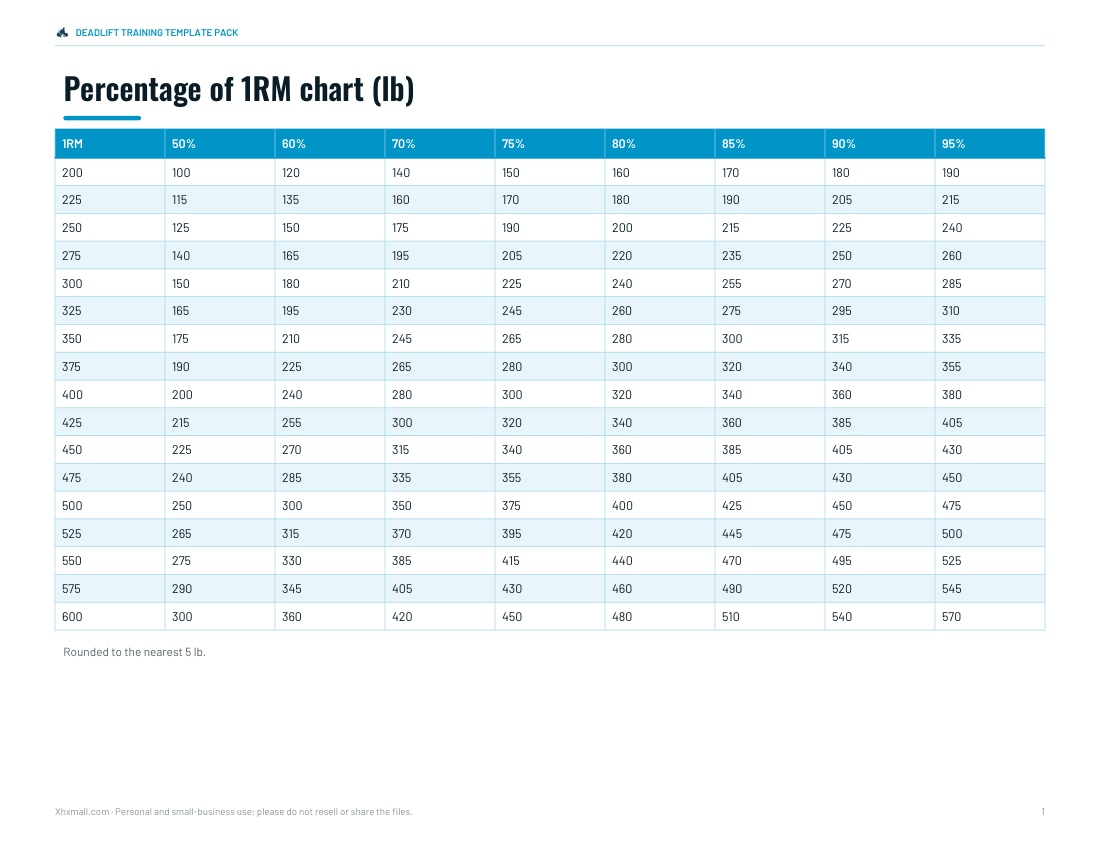
 Printable Deadlift Percentage Chart
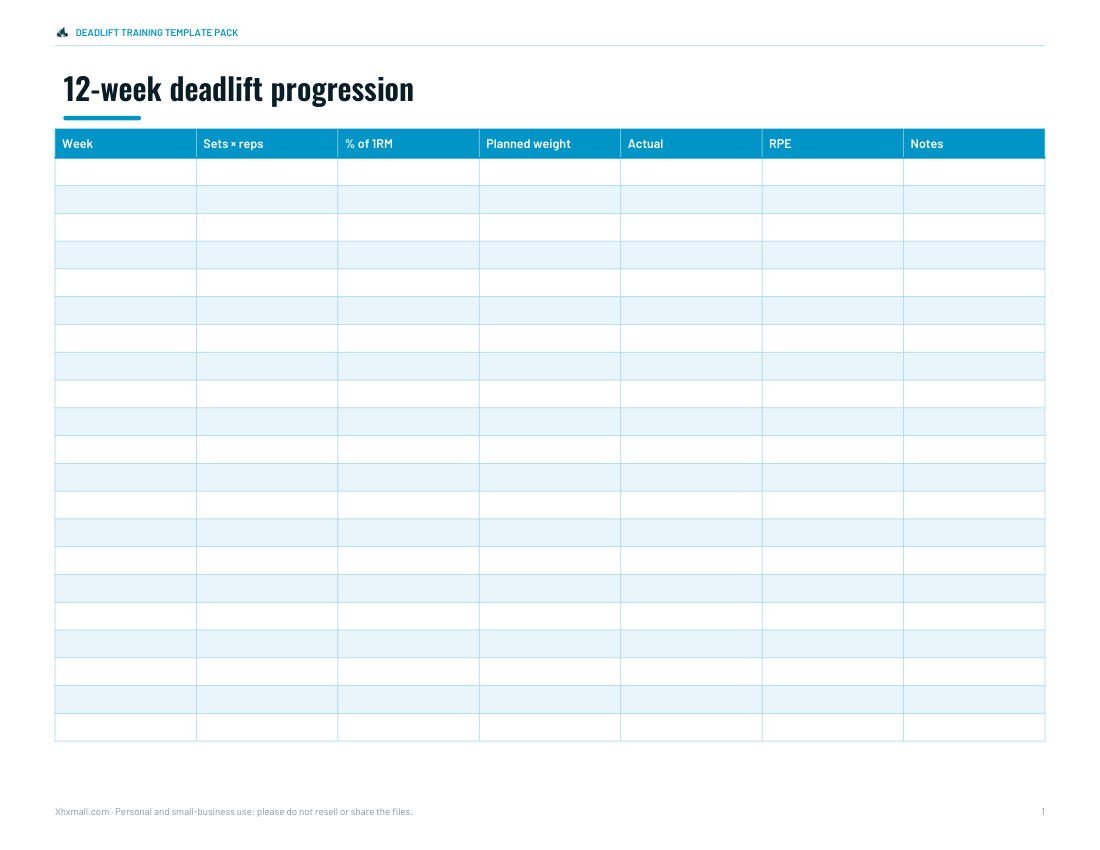
 Printable Deadlift Progression Template
 Deadlift Warm-Up and Plate Loading Chart
 Printable PR Tracker
The formulas
| Formula | Equation (w = weight, r = reps) |
|---|---|
| Epley | w × (1 + r/30) |
| Brzycki | w × 36 ÷ (37 − r) |
| Lombardi | w × r^0.10 |
| O’Conner | w × (1 + 0.025 r) |
| Mayhew | 100 w ÷ (52.2 + 41.9 e^(−0.055 r)) |
| Wathan | 100 w ÷ (48.8 + 53.8 e^(−0.075 r)) |
All six are published prediction equations from strength research. They agree closely for low reps and drift apart at higher reps, so the calculator shows each one and their average.
Worked example
A lifter pulls 315 lb for 5 reps. Epley gives 315 × (1 + 5/30) = 367.5 lb; Brzycki gives 315 × 36 ÷ 32 = 354.4 lb; the six-formula average is about 364.7 lb. Their training chart puts 85% — for sets of 3–5 — at about 310 lb, and 75% for sets of 6–8 at about 275 lb. At 185 lb bodyweight, the estimated max is 1.97 times bodyweight.
Using percentages to train
| % of 1RM | Typical reps per set | Training focus |
|---|---|---|
| 90–100% | 1–3 | Maximal strength, peaking |
| 80–90% | 3–6 | Strength |
| 70–80% | 6–10 | Strength and muscle growth |
| 60–70% | 10–15 | Muscle endurance, technique |
| 40–60% | warm-up | Warm-up sets and speed work |
Rep ranges at each percentage vary between people and lifts — the deadlift in particular is often done for fewer reps because of fatigue. Many programmes also use RPE (rate of perceived exertion) to adjust daily loads.
Deadlift technique reminders
- Bar over mid-foot, shins close to the bar.
- Brace your trunk before the bar leaves the floor.
- Push the floor away; keep the bar close to your legs.
- Lock out by standing tall — no need to lean back.
- Lower under control; reset between reps if form breaks down.
- Stop a set when form deteriorates, not when you fail.
Tracking progress with estimates
Because the calculator works from any hard set, you can estimate your max every week without testing it. Log your top set each session in the training log: if the estimated max rises over several weeks, your strength is improving, even if you never attempt a single heavy rep. Estimates bounce around a little from day to day with sleep, stress and technique, so look at the trend over a month rather than one session.
Sumo vs conventional
| Style | Stance | Notes |
|---|---|---|
| Conventional | Feet about hip-width, hands outside the legs | Longer range of motion; heavy on the back and hamstrings |
| Sumo | Wide stance, hands inside the legs | Shorter range of motion; more hip and quad involvement |
| Trap-bar (hex bar) | Stand inside the bar, neutral grip | More upright torso; often easier to learn |
Estimates are specific to the style you lifted — a sumo max and a conventional max can differ noticeably.
Grip and equipment
- Double-overhand grip is simplest but often limits heavy pulls; many lifters switch to a mixed or hook grip for top sets.
- Chalk improves grip on heavy sets where your gym allows it.
- Lifting straps take grip out of the equation — useful for back-focused accessory work, though not allowed in most powerlifting competitions.
- A lifting belt can help some lifters brace; learn to brace without one first.
- Flat, firm shoes or bare feet (where permitted) give a stable base.
Why estimates vary between formulas
Each formula was fitted to a different group of lifters and exercises. Some (like Brzycki) assume strength falls off quickly as reps rise; others (like Lombardi) assume it falls more slowly. People with more endurance-type muscle fibres may do more reps at a given percentage than the formulas predict, and very strong, experienced lifters often do fewer. That’s why the calculator averages them and shows the spread.
Safety
Testing a true one-rep max carries more risk than estimating it. If you do test, warm up thoroughly, use good technique, have a coach or experienced lifter watching, and stop if form breaks down. Beginners generally don’t need to test maxes at all. Anyone with health concerns should check with a doctor before heavy lifting.
What’s in the template pack
- Training log spreadsheet with automatic estimated 1RM from every set
- Printable percentage chart from 40% to 105%
- 12-week deadlift progression template
- Warm-up and plate-loading sheet
- Personal records tracker
The pack is a one-time download; the calculator is free.
Frequently asked questions
How do I calculate my deadlift 1RM?
Enter the weight and reps of a hard set; formulas like Epley estimate the max.
Which 1RM formula is most accurate?
None is best for everyone; averaging several helps, especially at 2–6 reps.
How many reps should I use for an estimate?
Sets of 2–6 reps to near failure give the best estimates.
Does it work for other lifts?
Yes — squat, bench press and others use the same formulas.
What is a good deadlift?
It depends on age, sex, bodyweight and training history; compare with your own progress.
Can I use kilograms?
Yes — switch units to kg.
How often should I test my max?
Many programmes test only every few months; estimating from working sets is safer in between.
Is a lifting belt included in the estimate?
The estimate reflects whatever you used in the set; be consistent when tracking.
What is RPE?
Rate of perceived exertion — a 1–10 scale of how hard a set felt, often used alongside percentages.
Should beginners use percentages?
Many beginners progress well by simply adding a little weight each week with good form.
Why is my estimated max higher than my real max?
High-rep sets tend to over-predict for some lifters; use sets of 2–6 reps for better estimates.